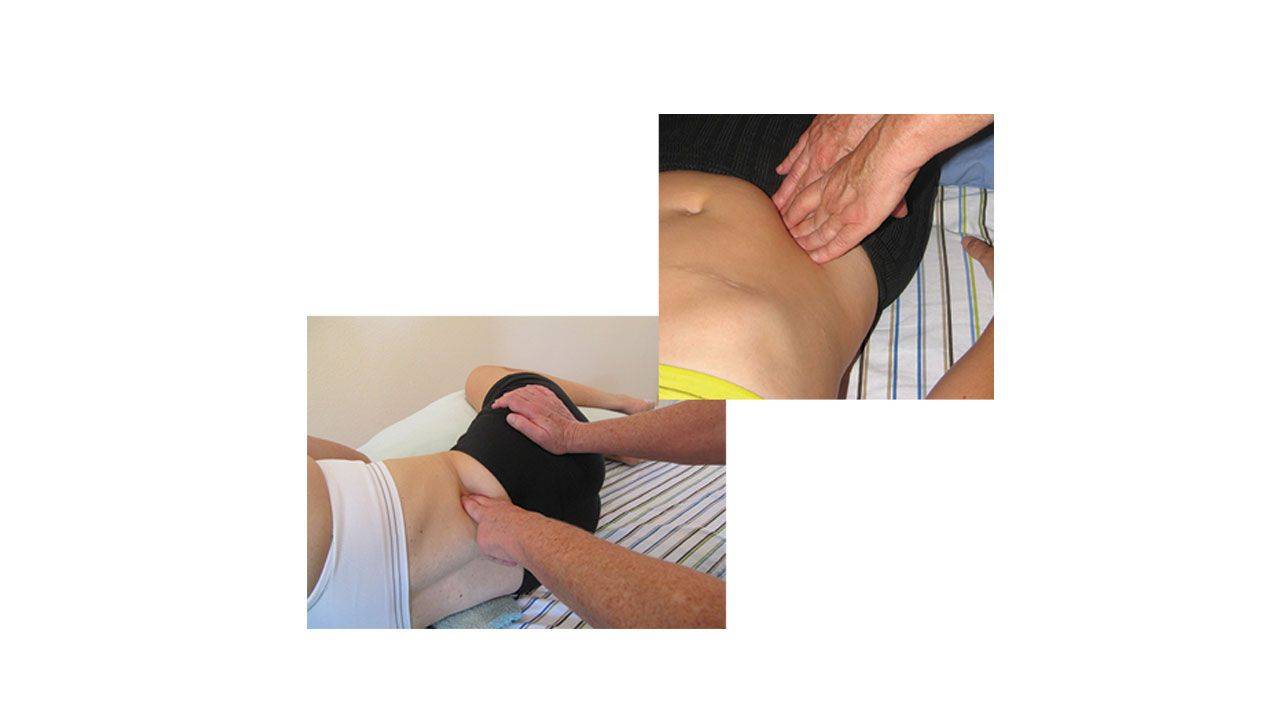
The delicate balance between the psoas and the piriformis

Recently, one of my students asked me to write about working with the piriformis. She had several clients experiencing piriformis syndrome and was getting frustrated with inconsistent results.
Piriformis syndrome—sometimes called piriformis dysfunction—goes by many names and is often misunderstood. I want to bring more clarity to this topic and share a broader, more effective way of looking at it.
If you’ve ever experienced it yourself, or if you treat clients with piriformis syndrome or sciatica, you know how intense it can be. It’s deeply painful and often creates wide-ranging referred pain. That’s why understanding this muscle in isolation isn’t enough—we need to see the full ecosystem.
Let’s start with the role of the piriformis then we’ll go around the corner to the psoas:
Piriformis acts as an external rotator of the hip and, in certain positions, becomes an internal rotator. It is extremely sensitive to anything happening around the sacroiliac (SI) joint because it attaches directly to the sacrum. It also functions as a kind of “monitoring system” for the spine—constantly sensing what’s happening up at the cervical spine and making tiny corrective adjustments at the sacral level, like a pilot constantly course-correcting during a flight.
It stabilizes the SI joint, the base of the spine, and the pelvis, helping coordinate movement from one side of the body to the other. In other words, the piriformis wears many hats. It’s not just a rotator—it’s a key player in global stability.
When the piriformis becomes painful, most treatment approaches target it directly. And while that can help, these techniques are often far too aggressive for such a sensitive structure. The piriformis does not respond well to force. In my work, I never recommend foam rolling over the piriformis because it tends to create more guarding, not release.
The body doesn’t release because it’s forced to.
It releases when it feels safe enough to let go.
This is basic neurobiology. Muscles are designed to resist sudden change. Only slow, patient, non-threatening pressure allows the nervous system to stop firing protective reflexes.
Now, let’s add the missing piece most therapists overlook: the psoas.
The piriformis and the psoas are in a delicate, highly intelligent relationship. Both connect the femur to the spine through myofascial chains. When they are in a fully lengthened, balanced state across the SI joint, the system works beautifully.
But when the psoas becomes shortened, braced, or protective, it pulls the lumbar spine into extension and drags the sacrum with it. That shifts the sacrum into nutation. The piriformis—being hypersensitive to SI joint mechanics—responds by trying to counter-nutate the sacrum. Now we have a tug of war.
The psoas is bigger and stronger. The piriformis is smaller, more reactive… and often the one that becomes painful.
This is why Ida Rolf’s words are so powerful:
“Where the pain is, the problem is not.”
Until both muscles find a fully lengthened, cooperative balance, the system stays locked. And no amount of aggressive local work on the piriformis will permanently fix it.
Let me share a quick case study.
I worked with a woman who had suffered from chronic piriformis pain for years. She had gone the traditional route: injections, ablations, chiropractic work, Airrosti, and repeated deep tissue treatments—always with only short-term relief.
During my intake, I discovered that every practitioner had worked only on the painful areas.
I also used a powerful assessment tool called the Movement Threat Screen to assess her nervous system response. Her threat level was extremely high. (I’ll be teaching this tool in-depth in an upcoming webinar: The Functional Shoulder: What Every Bodyworker Should Know.)
Here was the treatment paradigm I used:
• Positional Release for the psoas
>>>>Click here see the video for the lovely and calming psoas positional release technique<<<<
• Gentle assessment and MET corrections for the pelvis, sacrum, SI joint, and lumbar spine
• No deep tissue for the first three sessions—my primary goal was to calm her nervous system
Only after her system found more balance did I add focused manual therapy for the iliopsoas and quadratus lumborum. I did very little direct work on the piriformis because it had already been overworked.
Within six sessions, her pain dropped to a 1/10. She could sleep. She could move. And most importantly, her body could hold the corrections.
If this post resonates with you, you'll love my master class:
In this one-hour training, you'll discover how anatomy, the nervous system, and pain science work together to influence movement, protection, and healing. You'll gain a deeper understanding of the iliopsoas and quadratus lumborum—and learn why understanding the body is about much more than muscles alone.
**See deeper. Think clearer. Treat better.**
👉 Learn more here
Stay connected with news and updates!
Author

Peggy Lamb
Author
Peggy Lamb, LMT, BCTMB, MA is the founder of Massage Publications/The Abundant Bodyworker providing resources for massage therapists with continuing education courses, books, videos and business coaching. Her coaching and course work empower LMT’s so abundance and prosperity flows into their lives. Although a bit of a "reluctant businesswoman" she nevertheless has built multiple streams of income through her various projects. Peggy brings her eclectic and extensive background into her teaching for an interesting, enjoyable and enlightening learning experience. In addition to her extensive training in massage therapy, Peggy holds a master’s degree in Dance from American University in Washington, D.C. She has volunteered for over 10 years with “Truth be Told”, teaching creative movement and writing to incarcerated women. When she’s not working, Peggy can be found dancing, swimming in Austin’s Barton Springs, hiking or even dog sledding.